

New Papyrus Publishing
Bruton Parish, Virginia Register, 1662-1797
Bruton Parish, Virginia Register, 1662-1797
Couldn't load pickup availability
Transcribed & edited by John Vogt.
From the Author's Note:
"Why re-transcribe a parish register which has been available for almost forty years?" The answer is two-fold. Clerk hands from the seventeenth and eighteenth centuries are often difficult to read, and the author’s training in paleography quickly pointed out more than four hundred mistranslations when comparing the earlier printing with photostats of the original.
More important than the mistranslations, however, were the intentional omissions. As Professor Charles Julian Bishko of the University of Virginia once remarked, "historians should refrain from making judgments about other times based upon their own set of moral values. Their responsibility is to record events in an objective manner."
The earlier transcribers wrote at one point in their 1966 publication
"p. 37 to 68/69 Baptism:: of Slaves is omitted as it would be of little genealogical help."
and again at the end of the publication they reminded the reader for a second time
"Note: Pages of entries containing baptisms of slaves only were omitted."
In examining the original sheets, the current transcriber was dismayed that not only had entire pages been left out, but oftentimes slave baptisms interspersed within the main text were omitted. In all, MORE THAN TWO THOUSAND BIRTHS AND BAPTISMS OF AFRICAN-AMERICANS WERE MISSING! (Cf. Index under listing "Slaves"). The genealogical value of such records are enormous, not only for black historians and genealogists seeking their own roots, but for scholars documenting the culture of slavery as it existed in colonial Virginia. For example, a baptismal pattern emerges from the slave pages. It would appear that the traditional date for bringing slaves to the church for baptism was the first Sunday in each month, unless a major feast day fell on that date. This pattern was evident from the very earliest recordings in the 1730s until the mid 1760s. Only in the spring of 1768 and occasionally thereafter were slave baptisms moved to the second Sunday of the month. The reason for this change is as yet unclear.
The ambivalent role of free blacks in Virginia society at this time is also evident in the parish listings. Occasionally, free-born black children were entered within the congregational portion of the parish record. This was particularly true in the earlier decades until the mid-eighteenth century. Beginning in the 1750s, however, they are generally included within the lists of slaves baptized within the parish. In all, the register records the baptism of fifty-seven free blacks. These have been collected as a group in the index for quick reference (See "Indexing Conventions," page 93).
The parish register which survives covers the years 1662, twelve years before the formation of Bruton Parish (these records are those of the earlier Middleton Parish) up past the American Revolution to the mid 1790s. It records life events for both the great men of society as well as artisans, children, servants, slaves, bastard children, and reflects a cross-section of the Williamsburg community during its heyday when it served as the capital of the colony. More than 3,400 entries list either births, baptisms, deaths, or burials. There are no marriage records.
The editor has provided a meticulous transcription of the register, using his training in colonial paleography to correct many of the previous mis-readings. A full index is included as well as an extensive introduction. This will provide valuable information for anyone with family in the York/James City/Williamsburg area during the eighteenth century.
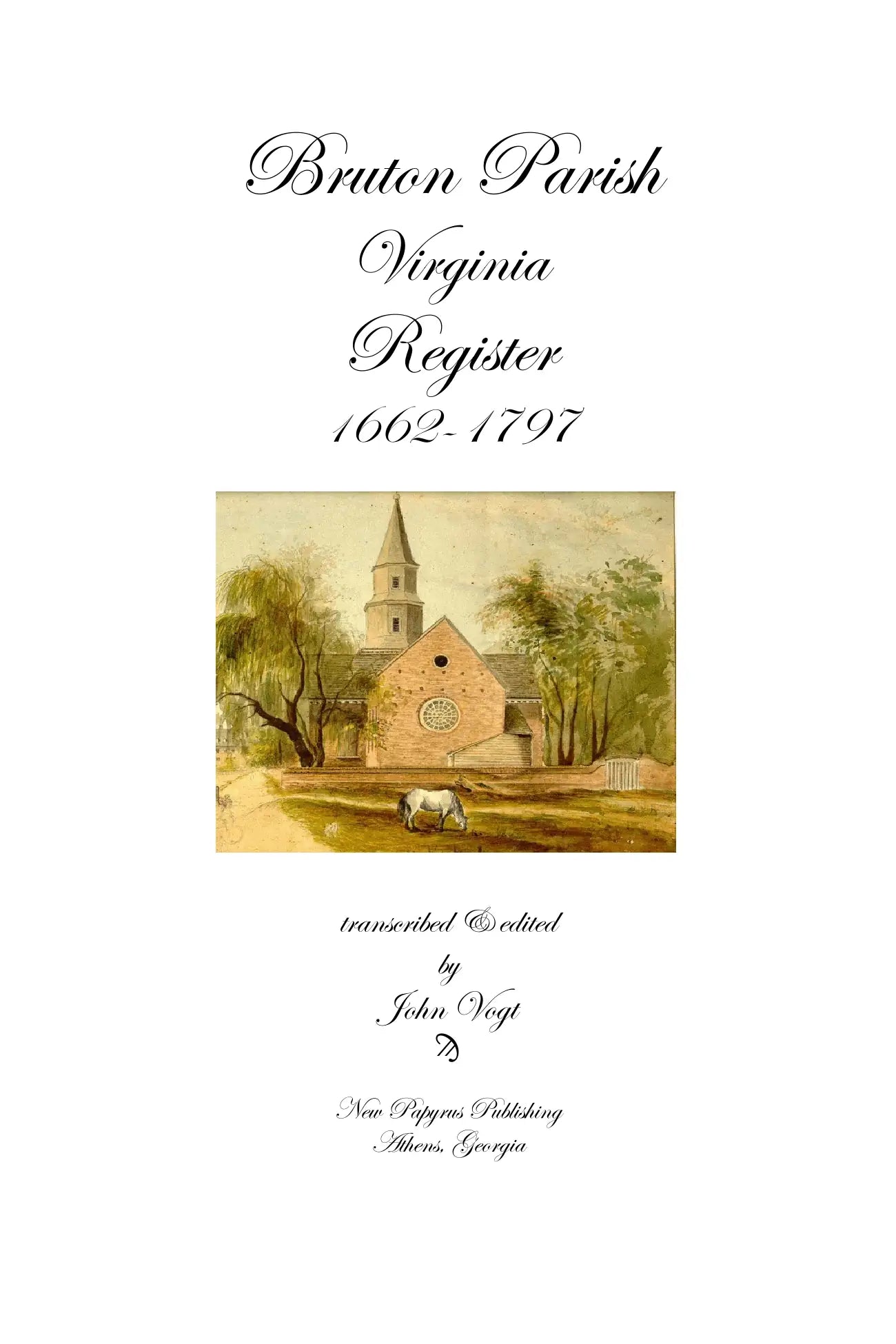
Dating from 1715, Bruton Parish Church in Williamsburg is the third in a series of Anglican houses of worship that began in 1658. The first, which may have been at or near the 18th-century site, was built, probably of wood, in the Old Fields at Middle Plantation, Williamsburg's name until the 66-year-old community was incorporated in 1699.
Formed from Middletown and Marston Parishes in 1674, Bruton Parish was about 10 miles square. It is named for Bruton, Somersetshire, in England, the home of then-Governor William Berkeley and Virginia secretary Thomas Ludwell. As late as 1724, the parish contained only 110 families.
The church stood near the center of Williamsburg's original survey map drawn 15 years later. Its location suggested the church's importance to the colonial community's life. Virginia governors, from the time of Alexander Spotswood, were provided with a canopied chair on a platform inside the rail opposite the raised pulpit with its overhanging sounding board. Parishioners sat in boxed pews, their walls providing privacy and protection from drafts. In the early years the sexes sat apart. A vestry book entry for January 9, 1716, says: Ordered that the Men sitt on the North side of the church, and the women on the left.
Among the Williamsburg notables buried beneath the marble flagstones inside the church was Governor Francis Fauquier, one of the best loved of the colonial governors, who died in 1768. The same year an English organ was installed. Gaolkeeper Peter Pelham was hired to play it and he brought to church with him a prisoner from the Gaol, whose job it was to pump the instrument.
Among the men of the Revolution who attended Bruton Parish Church were Thomas Jefferson, George Washington, Richard Henry Lee, George Wythe, Patrick Henry, and George Mason.
Indexed.
Share
Details
-
Bruton Parish, Virginia Register, 1662-1797
John Vogt
-
Binding: Soft Cover
Copyright: 2004
Pages: 119
Size: 8 x 10 in.
Condition: New

About us
Collector Bookstore is a leading specialty retailer of price guides and reference books to inform and educate collectors and professionals in the antiques and collectors markets. Our customers include individual collectors, dealers, appraisers, auctioneers & other industry professionals.